
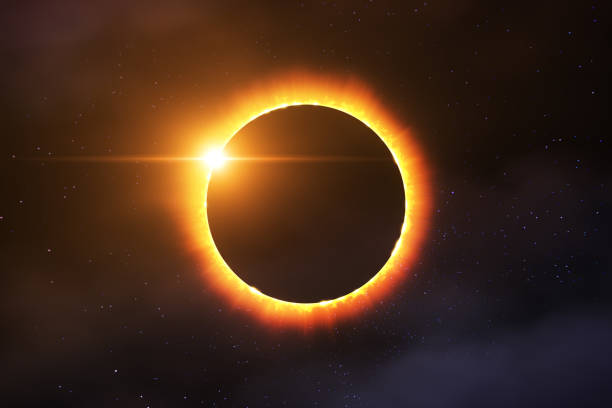
There are various opinions regarding the impact of an eclipse on our eyesight.
Some claim that observing an eclipse with bare eyes can cause nerve damage, while others argue that the absence of strong light makes it less harmful, rendering plain eye observation of an eclipse perfectly harmless.
Instead of deciding this matter by aligning ourselves with someone else’s opinion, let’s examine the facts and make a decision based on those facts.
The eye controls how much light it allows to pass through to the optic nerve. The control is done by the Iris that controls the opening and exposure of the light to the eye lens. The opening we call a Pupil. The stronger the light, the smaller the Pupil. The smaller the pupil, the less light can reach the eye lens and the optic nerve, preventing overexposure and possible eye nerve damage.

We also help control eye exposure to light by contracting the muscles that control the fascial muscles, and we call this squinting.
When a lesser amount of light is available, the Iris relaxes, the Pupil enlarges, and more light will penetrate, making it possible for us to see in low-light areas.
Let’s examine what happens with the sunlight during the day.
We are being told that sungazing is a good thing, but we should do it only during the early morning hours or just before sunset. Why?
When the Sun is closer to the horizon, the sunlight has to pass through more polluted air. The sunlight is reaching us through the lower atmosphere, which is more polluted, and the pollutants are interfering with the sunlight, causing a shield. Something similar to this we create when we use sunglasses. We create an obstacle to the flow of the light. Less light will open our Pupil and more light will reach the optic nerve.
Basically, no matter what we do, we will adapt to the light exposure. This makes sunglasses obsolete; we do not need them at all, but when our cells are dehydrated, the tissues they create do not perform correctly. This also affects our eyes. The Iris does not tighten enough, and cannot relax enough. This is the same with the eye lens. We become more sensitive toward light, and our vision worsens.
When the Sun is high in the sky, the sunlight has to pass a shorter distance through pollution. More sunlight will reach our eyes, and our pupils will become very small, restricting this light’s exposure to the eye nerves. We say that the sunlight is strong.
Another important thing we have to consider is the frequency of sunlight.
We know that when the sunlight goes through a prism, the white light splits into an array of colors. The colors go from red to orange, then yellow, green, blue, and violet.
Every color represents its particular frequency. The longest frequency bends the least, and this is why it penetrated deeper. The ultraviolet is of short frequency, and this is why it bends the most, which makes it the least penetrable. This means that the infrared will penetrate deepest, and the ultraviolet will have the poorest penetrating force.
The frequency that penetrates the deepest will have more effect on the sensory nerves and will affect deeper layers of the skin, causing heat and a burning sensation.
Because of its short wavelength, the ultraviolet light cannot penetrate much. We say that it becomes absorbed. Since the ultraviolet light, because of its particular frequency, causes pigment activation, when we are behind a glass/window, we will not obtain color/pigment, but we will feel the heat. The ultraviolet rays could not penetrate the glass, but the infrared did, causing heat.

Even mild clouds will prevent the ultraviolet rays from reaching our skin and eyes, yet we are being told that the ultraviolet light is very destructive. We are told that exposure to too much violet light will cause cataract, which is untrue. Sunlight does not cause any health issues other than heat, and this is because of the red and infrared spectrum of sunlight and not the ultraviolet light, as we are wrongly indoctrinated to believe.
As I have explained through my articles and videos, sunlight heats the skin, causing a necessity for cooling. This relaxes blood vessels and brings more lymph to cool down the area. If toxicity is present, toxic elimination occurs, causing symptoms of toxic bubbles, which we refer to as sunburn.
What I am trying to explain is that the ultraviolet light may irritate only the superficial layer of the skin and cornea, which will not cause a sensation of pain because the ultraviolet frequency cannot penetrate and cause any heat. No discomfort will occur. We are not aware that we are being exposed to this frequency. This is what makes it a problem, as the possibility of overexposure without detection is present. We know that even the beneficial things become toxic if we saturate the body with them. Surplus has to be eliminated because it causes stagnation and harm.
Let me explain why all of this information is necessary to make a correct conclusion when an eclipse is in question.
As the Moon blocks part of the Sun, less light reaches us, and darkness occurs. Our pupils open to allow more light in so that we can see the best possible. Since less sunlight reaches our eyes, less heat is created, and we can look directly into the Sun. So far so good.
We know that shorter frequencies/waves refract/bend more than longer frequencies. During an eclipse, less red and infrared light will reach our eyes, making us comfortable, but since ultraviolet and violet light curves more ( light is a wave and it curves around obstacles), more ultraviolet light will reach our eyes than infrared, and since the Sun is right above us, the atmosphere is clear. We will be comfortable, but our eyes will be exposed to more violet light.
This is why we are told to use glasses, but we do not need dark glasses. We can simply use a thin window type of glass since ultraviolet rays will be absorbed in it. That’s all.
If we do not intend to stare into the eclipse for longer than a minute or two, no harm can result, and no glass is necessary.
What we are told about the danger to observe eclipse and the necessity of dark, preferably welding glass, to be safe, is pure nonsense.
I hope that this explanation makes sense to you, but this is how I reason when eclipse is in question.
This is an example that shows that the more information our brain has, the better it can calculate. This is why we have to be open to receiving all kinds of information, because this empowers us to recognize the truth. The more information our brain is exposed to, the closer to the truth we can get.
Love and light to us all.